The Jemaa el-Fnaa after dark, the quarter around Ben Youssef, and what a coffee actually costs.
VisitedYes — in person
Trip dates27 December 2025 – 3 January 2026
Prices last verifiedSeptember 2026
Sights covered4
The short version
Jemaa el-Fna is free, open and best after dark. The food stalls go up in the late afternoon and the square runs past midnight.
Jardin Majorelle and the YSL museum cannot be bought at the gate. Online only, in thirty-minute slots, since January 2023. We did not book ahead and they were sold out — that is the one mistake on this page.
Bahia Palace is 100 DH (about €9) for a foreign adult, 09:00–17:00. We went; parts are still fenced and tarped from the 2023 earthquake.
Le Jardin Secret is the one to add if you have a spare hour. Two walled gardens and a tower with the best free-standing view of the medina roofline.
Late December is around 20 °C in the sun — and it rained on us. Pack for both.
Madrasa Ben Youssef is 50 DH (about €4.60), open 09:00–19:00 daily, tickets at the door only — their online system is down.
Both Villa Oasis and the YSL museum close on Wednesdays. The garden itself does not.
Jemaa el-Fna: Hours, Tickets & the Best Time to Visit (2026)
A market square that has been in continuous use for something like a thousand years, and the only reason to be anywhere else in Marrakech at eight in the evening. UNESCO put it on the Representative List of Intangible Cultural Heritage in 2008 — not for the buildings, which are unremarkable, but for the halqa, the circle of listeners that forms around a storyteller, a musician or a snake charmer. The same listing names tourism itself as the threat to it.
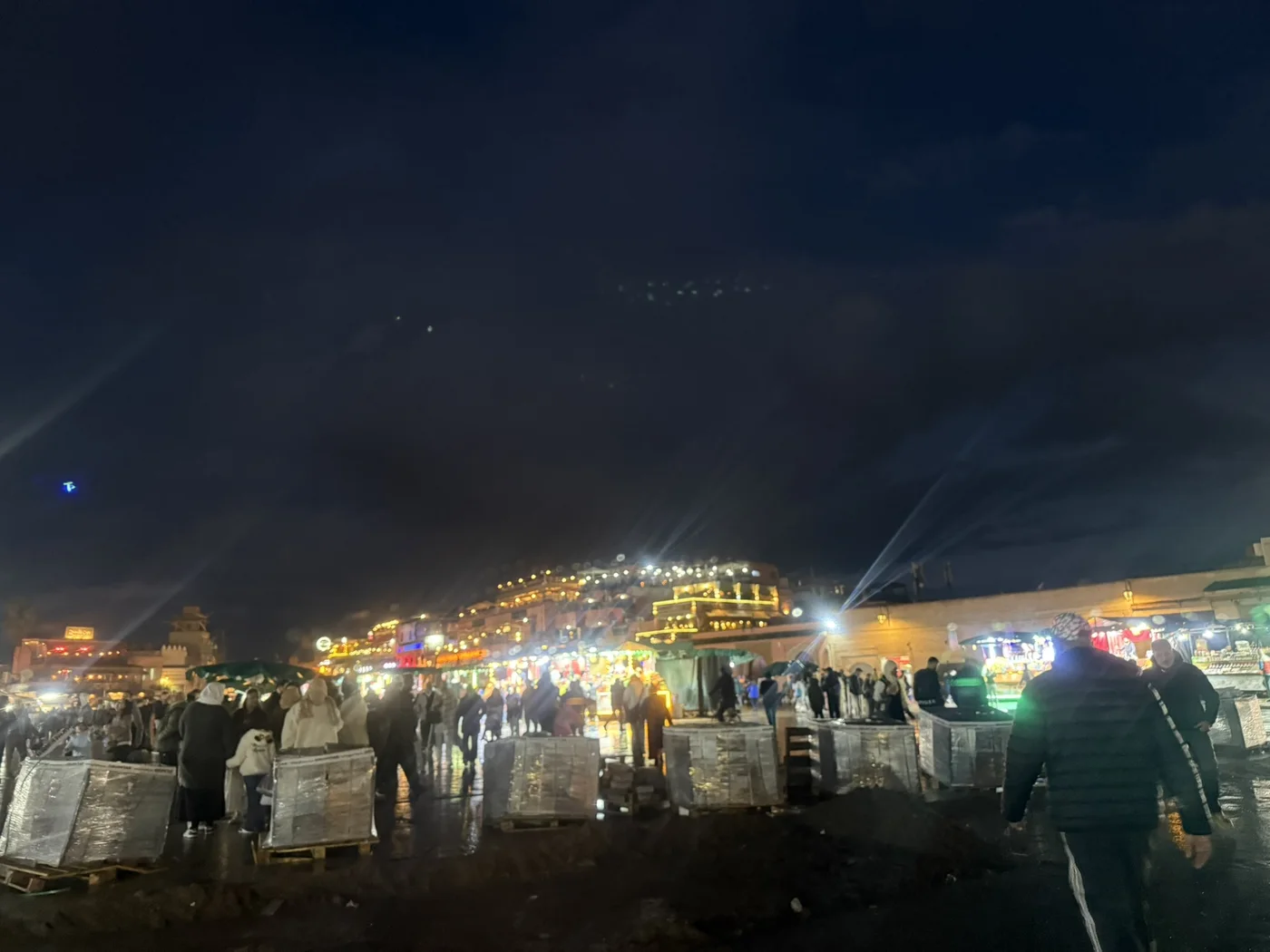
It changes completely across the day. In the morning it is a wide, ordinary, slightly scruffy open space with orange juice carts. From late afternoon the food stalls are wheeled in and assembled, and by dark it is a grid of numbered kitchens under gas lamps with smoke going straight up. We arrived in Marrakech in the afternoon and came here at nine; it was the right call and it is the one thing on this page we would not reorder.
On being photographed and photographing. There is no official tariff and no published rule. What is true is that the performers, the henna artists and the men with monkeys make their living from visitors and will ask for money once your camera is out — sometimes a great deal of it. Agree the number before, not after. We could find no citable official guidance on amounts, so we are not going to print one.
Opening hoursOpen square, no gates. Food stalls roughly late afternoon until after midnight.
PriceFree.
Advance bookingNone.
Free entryAlways.
Best timeThe hour after sunset, when the stalls are lit and the sky is still blue. Our photograph is at 19:08 in late December.
The Marrakech Medina on Foot: What an Afternoon Buys You
We landed, dropped bags, and walked north into the medina in the last of the light. That is not a plan, it is what is left of a travel day, and it is worth saying out loud: an arrival afternoon in Marrakech buys you the streets, not the monuments. Everything ticketed shuts between 17:00 and 19:00, and by the time you have cleared the airport it is gone.
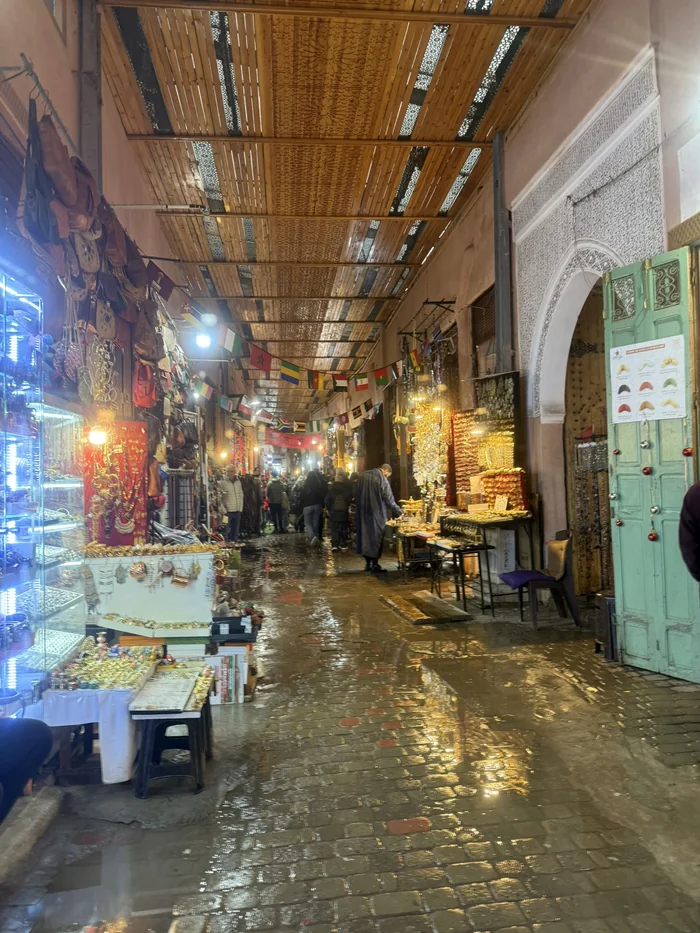
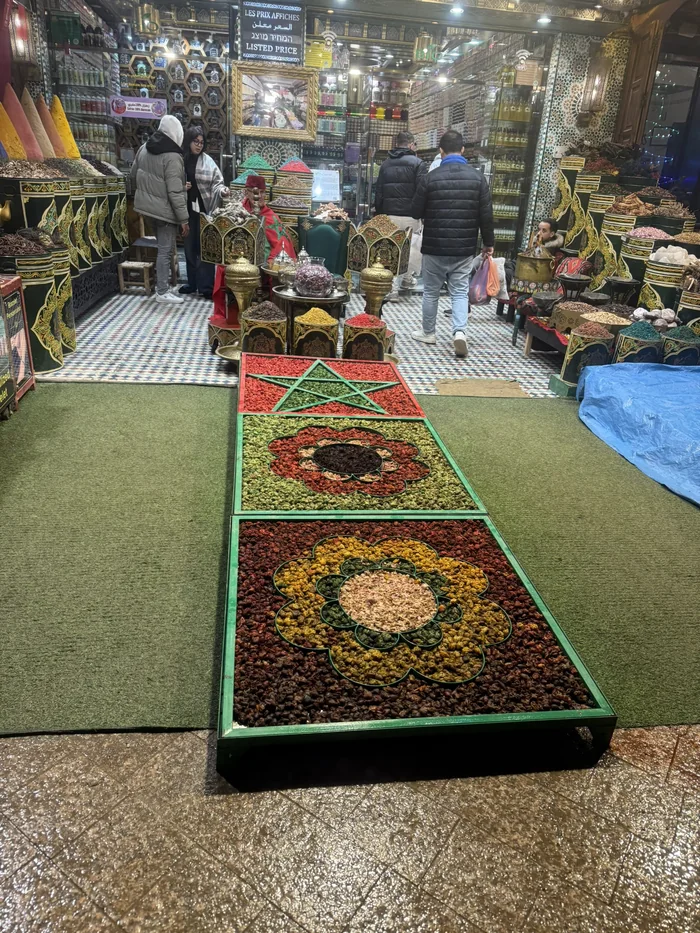
The covered souks. It rained most of our Marrakech days, which is not the postcard version and is worth knowing.Note the sign in the back of this one: LES PRIX AFFICHES · LISTED PRICE. Shops that post prices are a different experience from shops that do not.
Where we stayed. Two riads, both inside the medina: Riad Dar Tamlil(affiliate link) on the arrival night and
Riad Zagouda(affiliate link) for the two nights at the end, €77.25 and €150.48 respectively, for two people.
We would do the same again — see why a riad rather than a hotel on the
trip hub, including the part nobody tells you about arriving with luggage.
We went
Bahia Palace, Le Jardin Secret, and the Two That Sold Out
Two of these we walked round. Two we did not get into, for a reason that is entirely our own fault and is the most useful thing on this page.
Bahia Palace — we went, and it is worth the 100 dirham
A nineteenth-century grand vizier's palace, and the one state-run monument here, which means its ticketing is published by the Ministry of Culture rather than guessed at. It is also the one that most repays an hour: a sequence of courtyards that get progressively more decorated, and a painted cedar ceiling in the small riad that is better than anything else we saw in the city.
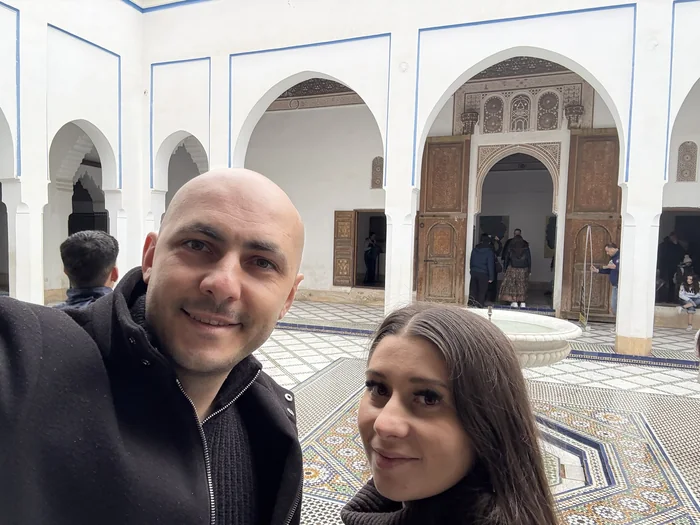
The marble courtyard. Plain white arcade, and then one carved doorway that stops you.
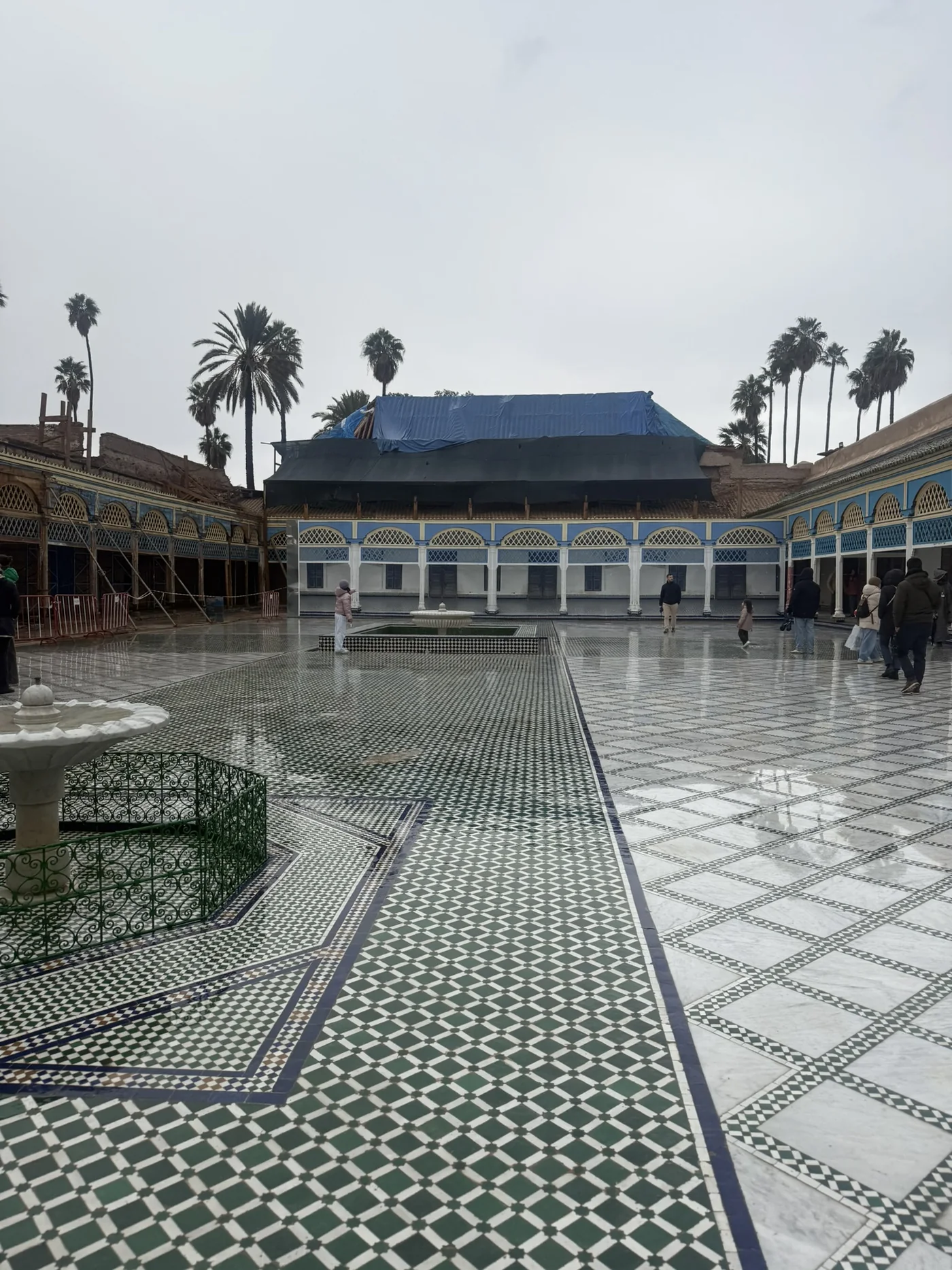
The great courtyard, with the earthquake repairs still tarped over one wing. The rain is doing the tiles a favour.
Expect building work. It was damaged in the September 2023 earthquake — cracks and a partial collapse in the grand riad and the Menzah — reopened a month later, and the rehabilitation is still going on. One whole side of the great courtyard was under tarpaulin and scaffolding when we were there. It does not spoil the visit; it does mean you should not expect the photographs you have seen.
Ignore the tariff PDF still sitting on the national tourist office website. It lists Bahia at 60 DH. The Ministry's own live portal charges 100. The PDF is undated and out of date, and it is the number most other guides are repeating.
Le Jardin Secret — the one we did not plan and would go back to
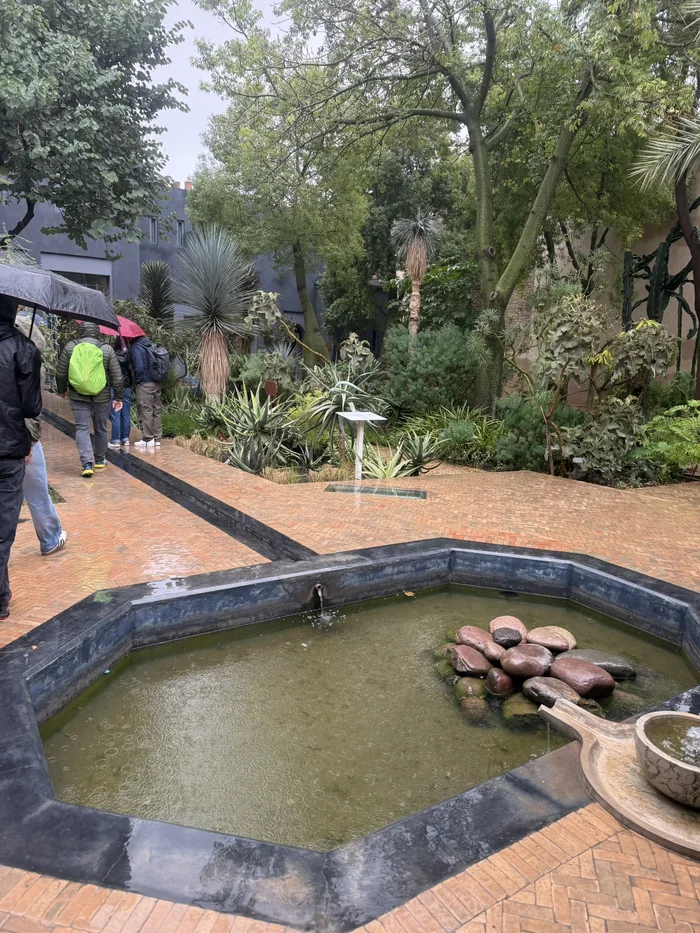
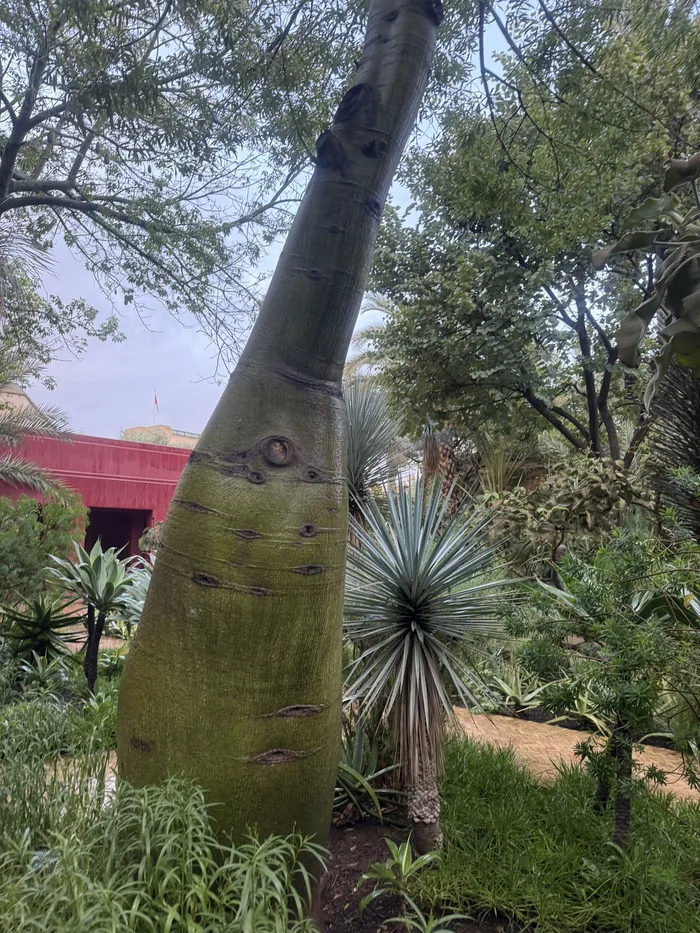
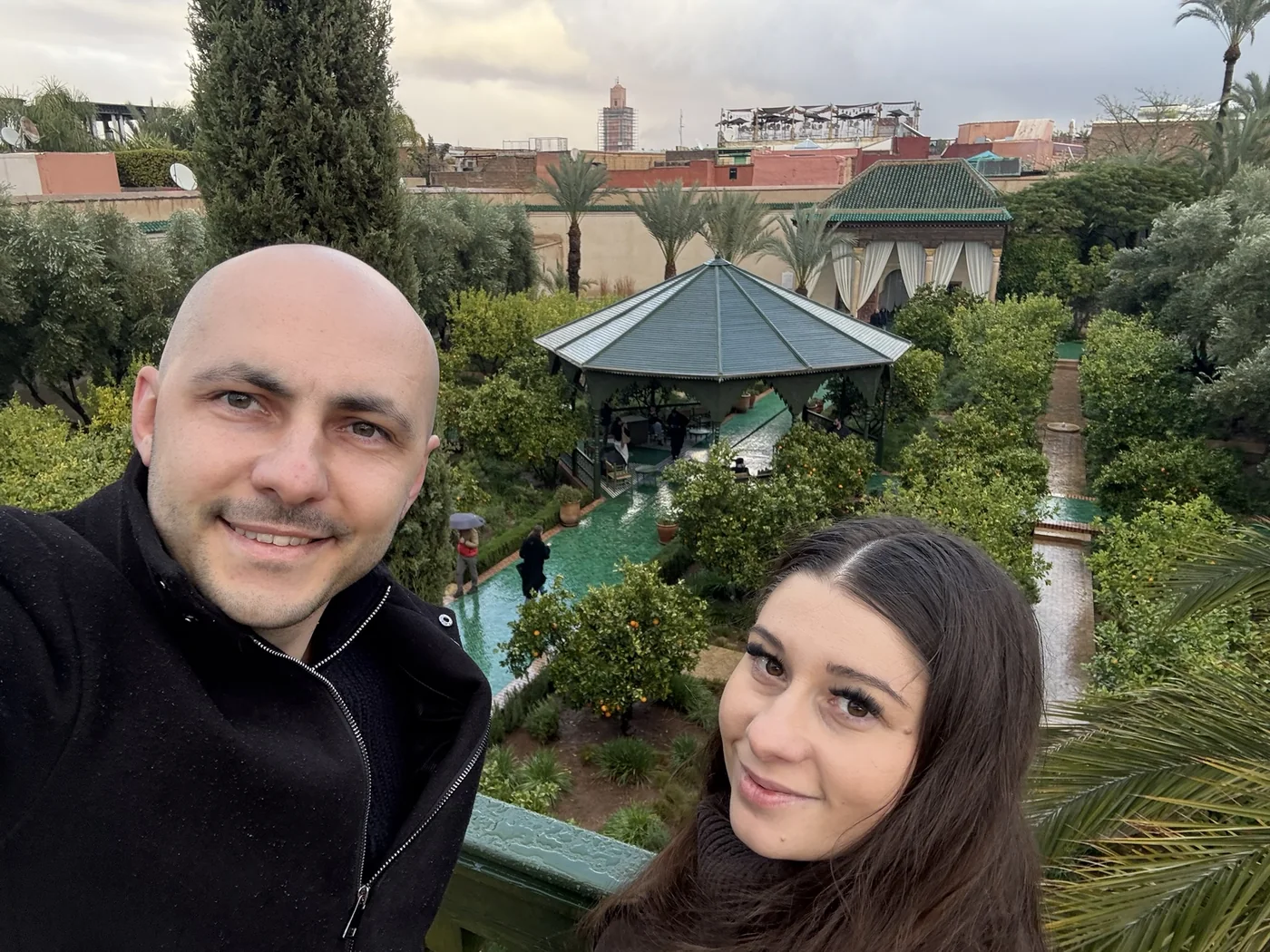
A restored riad complex in the middle of the medina with two walled gardens: an exotic garden of succulents, cacti and bottle trees, and a formal Islamic garden laid out in four quarters around a water channel, with a pavilion in the middle. There is a tower you can climb, and from the top you get the medina roofline, the palms and the minaret in one frame — which in a city with almost no public high ground is worth the entry on its own.
The exotic garden, in the rain. Everything in it is labelled, which is unexpectedly satisfying.The bottle tree against the red wall. This is the photograph everyone takes here, and rightly.
From the tower, looking down the Islamic garden to the pavilion, with the medina roofline behind.
Why this is a good wet-weather answer. Half of it is indoors, it is small enough to do in an hour, it is in the middle of the medina rather than a taxi ride away, and it does not sell out. If a Marrakech day falls apart — and ours did, twice, because of rain — this is the thing to put in the gap.
We did not keep the ticket, so we are not printing a price we cannot stand behind. Check lejardinsecretmarrakech.com before you go.
Madrasa Ben Youssef
A sixteenth-century Quranic school, reopened in 2022 after a long restoration, and the cheapest of the four by a distance.
Jardin Majorelle and the Musée Yves Saint Laurent — the mistake
We did not get in, and it was avoidable. Since 30 January 2023 the ticket desk at the gate is permanently closed and online booking in thirty-minute slots is the only way in. We had both on the plan, we did not book them in advance, and by the time we tried, every slot for our dates was sold out. That is late December in Marrakech: warm, popular, and fully booked.
So take this as the one hard instruction on the page. Book Majorelle and the YSL museum the moment your flights are confirmed — not the week before, and certainly not on the day. They are the only two things in Marrakech that will refuse you at the door, and they are the two most people most want to see. The foundation also warns about tickets sold on unauthorised sites, which it will not honour, so book on the official portal and nowhere else.
Koutoubia Mosque
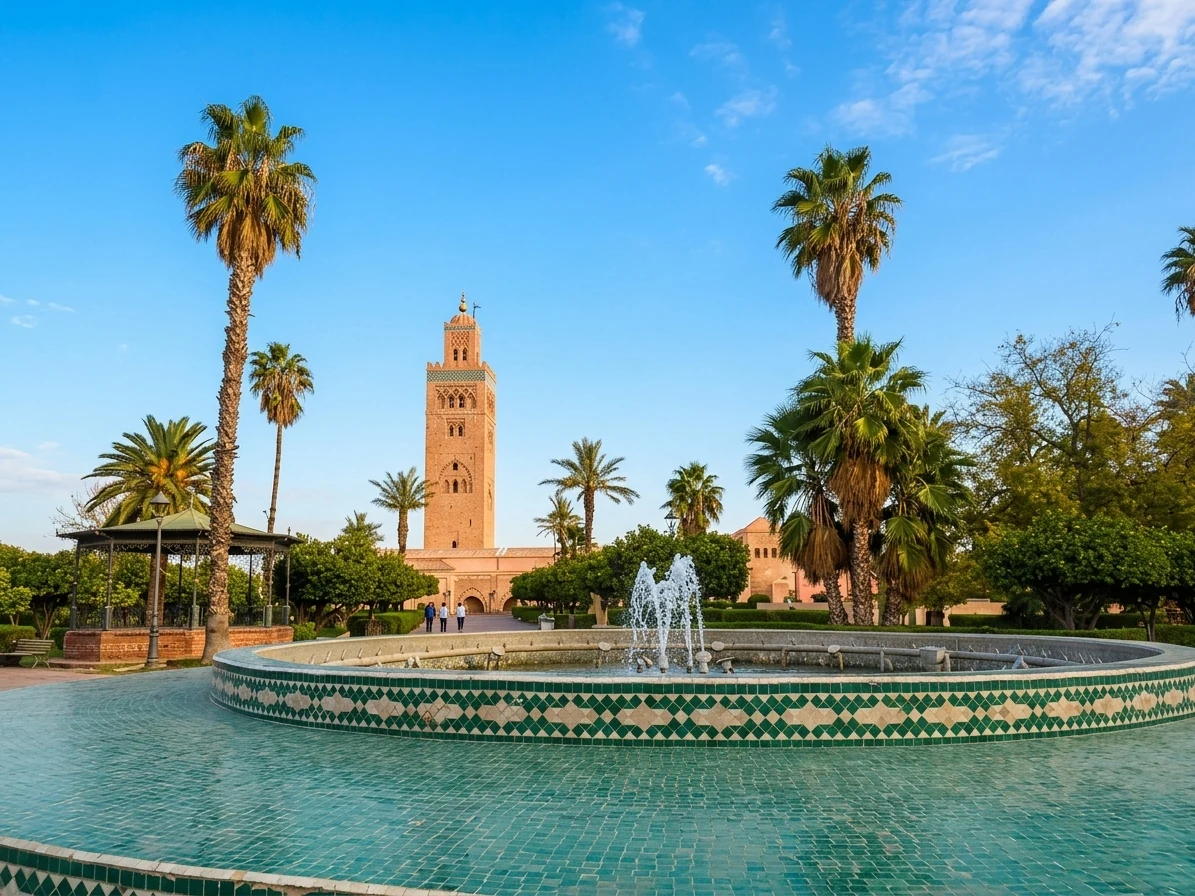
The 77-metre minaret that fixes your position anywhere in the old city. It closed after the 2023 earthquake and reopened in 2024. As at every working mosque in Morocco, non-Muslims are not admitted to the prayer hall — we could find no official statement of that anywhere, but it is applied without exception. The gardens beside it are a public park; we could not confirm official hours for them.
Opening hours09:00–17:00. The official page publishes no weekly closing day and no Ramadan hours.
Two people, every meal out, every day: about €30 a day. That is the real figure for the whole trip, not a cheap day cherry-picked out of it. Morocco is one of the few countries left where a good dinner costs less than the taxi to it.
Not all of it was in restaurants. A good share of our eating was street food in the medina — grills, sandwiches, harira, pastries, fresh orange juice — which is very cheap and very good, and is not a lesser version of eating here. Find a stall with a local queue and visible turnover, watch it cooked, and you will eat better for two euros than for twenty in a courtyard chosen for its photographs.
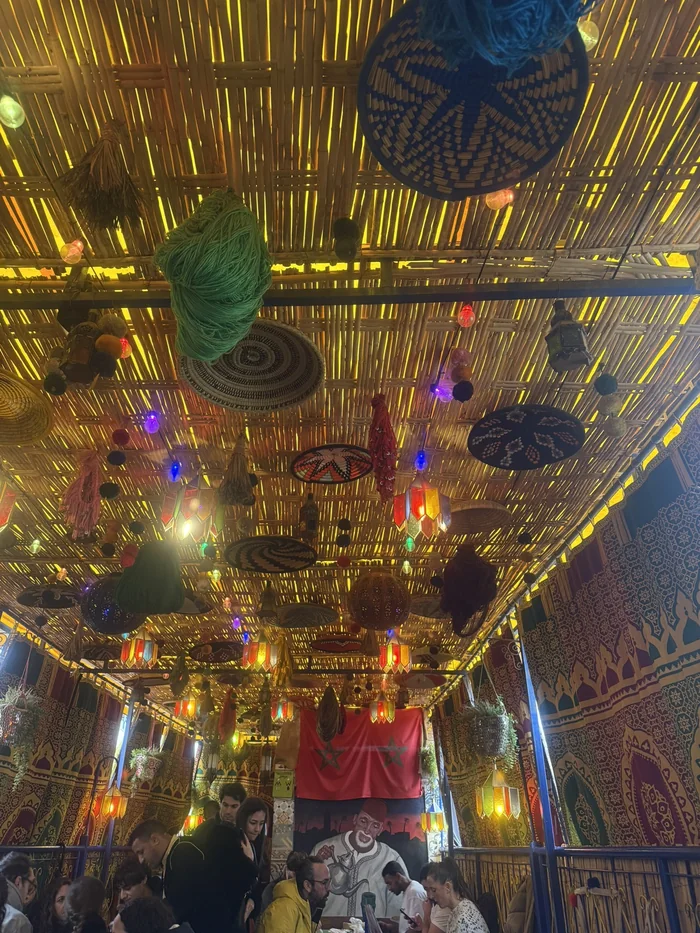
This is the kind of room to look for. Full, loud, decorated to within an inch of its life, and not a wine list in sight.
The rule that keeps the bill down
One choice does most of the work: eat where the room is Moroccan rather than where the room is comfortable. The reliable tell is alcohol. A restaurant licensed to serve alcohol in Morocco is dramatically more expensive than one that is not — the licence costs an enormous amount to hold, and that cost is spread across every dish on the menu, not just the drinks. A place without a licence has nothing to recover, so the same tagine, cooked just as well, costs a fraction of it.
None of which means eating badly. There are plenty of good places at good prices, and they are not hidden. Look for a room that is busy with locals, a short menu, a kitchen you can see, and decoration that was done for its own sake rather than for a photograph. If you want wine with dinner, fine — but know that you are paying several times over for it, and make that a decision rather than an accident.
Alcohol is legal for visitors in licensed restaurants, bars and hotels, and sold in the alcohol counters of some supermarket branches — but drinking it in the street is illegal and can get you arrested, and shops inside the medina do not sell it. Which branches stock it varies branch by branch, so do not trust a chain-wide list from an old article.
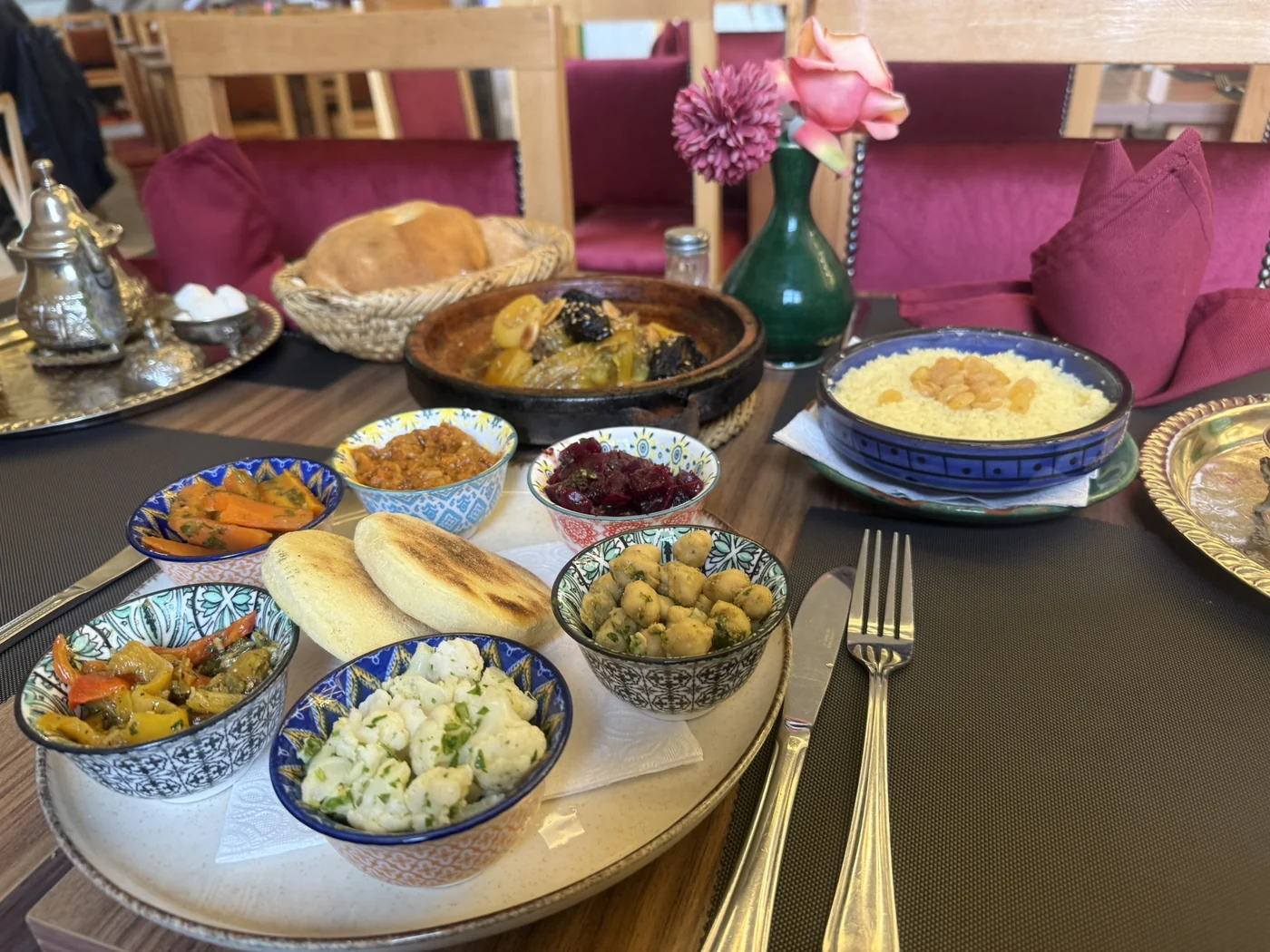
Lunch on our first day — a tagine, couscous, bread and six little salads between two. 27 Dec · 12:50
We went
Honest bit
What We'd Change About Our Marrakech Days
We let the desert tour eat the city day
Our plan had a full Marrakech day on it: Bahia Palace, Madrasa Ben Youssef, Jardin Majorelle, the Koutoubia. The three-day desert crossing took most of that time. We did get into the Bahia Palace, and we got Jemaa el-Fna after dark twice, which is the best of Marrakech — but that still leaves three monuments we can only write about second-hand.
Do this instead: treat a multi-day tour as a block that also consumes the afternoon before it and the morning after it. Put a protected day on each side, or decide in advance that the city is an evening and plan it as one.
Quick answers
Marrakech FAQ
Can you buy Jardin Majorelle tickets at the gate?
No. The on-site ticket desk closed permanently on 30 January 2023 and booking is online only, in thirty-minute timed slots. The foundation also warns that tickets bought through unauthorised resale sites will not be honoured.
How much is Bahia Palace in 2026?
100 dirham for a foreign adult, about nine euros, and 50 dirham for a child aged 7 to 13, on the Ministry of Culture's own ticketing portal. Opening hours are 09:00 to 17:00. The 60-dirham figure still circulating comes from an obsolete tourist-office PDF.
Can non-Muslims go inside the Koutoubia Mosque?
No. As at working mosques throughout Morocco, entry to the prayer hall is restricted to Muslims. The minaret and the gardens around it are what visitors see. No official page states the rule, but it is applied consistently.
What is open in Marrakech in the evening?
The square and the souks. Every ticketed monument in the city shuts between 17:00 and 19:00, so an arrival afternoon effectively gives you the streets and Jemaa el-Fna, and nothing that needs a ticket.
Which Marrakech sights close on Wednesdays?
The Musée Yves Saint Laurent and the Villa Oasis private garden both close on Wednesdays. Jardin Majorelle itself and the Berber museum stay open, and so do Bahia Palace and Madrasa Ben Youssef.
A little more adventure in your inbox.
The newsletter is being set up. Until it opens, write to us and we'll add you to the first send — and we'll answer any question about a trip while we're at it.